

When you shop for electricity in Texas, it’s easy to get drawn in by low advertised rates. But to understand what you’ll actually pay each month, you’ll need to take a closer look at the plan’s Electricity Facts Label, or EFL for short. However, EFLS can be quite intimidating to read if you’re not familiar with their format.
Below, we break down how to read an electricity facts label so you can make informed decisions about your energy plan.
What Is an Electricity Facts Label (EFL)?
An Electricity Facts Label (EFL) is a standardized disclosure document that all retail electricity providers in Texas are required to make available to shoppers before they enroll in a plan. It’s required by law from the Public Utility Commission of Texas (PUCT) to make it easier for consumers to compare electricity options.
“The aim of the Electricity Facts label is to give consumers a clear, informative and accurate guide to the electricity available to them.”
The EFL breaks down key details of your electricity plan, such as the:
- Average price per kilowatt-hour (kWh) at different usage levels
- Any recurring fees or credits
- Contract terms
- Percentage of renewable energy used by the plan
Find out why over a million customers trust Just Energy!
Why the PUCT requires EFLs
The EFL rule exists to protect consumers in Texas’s deregulated electricity market. With dozens of providers offering different rates and fee structures, it can be difficult to tell which plan offers the best value. The EFL ensures that all electricity providers present key pricing and contract information clearly, so shoppers can make informed decisions without having to dig through fine print.
Where to Find Your Plan’s EFL PDF
You’ll typically see a link to the EFL on the provider’s plan detail page. Look for a downloadable PDF labeled “Electricity Facts Label” or “EFL.” You can also find EFLs on third-party comparison sites like Power to Choose, which list them alongside plan summaries.
If you’re exploring Just Energy plans, you’ll find a direct link to the EFL right on each plan’s page so you can review the full terms upfront before enrolling.
Explore our electricity plans for Texas for more details.
Why the EFL Matters When Comparing Electricity Plans
The EFL presents plan details in a consistent format, making it easier to compare options side by side. In Texas, plans that appear similar often have significantly different prices. Some include low rates that only apply at certain usage levels or offer credits that disappear if your consumption drops.
Rather than relying on headline rates, the EFL shows your average cost at common usage levels, along with fees, contract terms, and renewable content, which gives you a clearer view of what you’ll actually pay.
Reading an Electricity Facts Label (EFL)
Your Electricity Facts Label includes several key sections that directly affect your monthly bill. Understanding how to read each part can help you spot a good deal or steer clear of one that might cost you more than expected.
This section is your step-by-step EFL guide, covering everything from usage pricing to hidden fees.
Electricity Price: average cost at 500 / 1,000 / 2,000 kWh
To fully understand EFL pricing, you need to familiarize yourself with the usage level tiers. Electricity providers in Texas must list the average price per kilowatt-hour (kWh) at these three usage levels:
- 500 kWh (low usage)
- 1,000 kWh (moderate usage)
- 2,000 kWh (high usage)
These averages include:
- Energy charge (from your provider)
- TDU delivery charges
- Any base fees or usage credits
Why your actual price may differ
Your actual cost per kWh may differ from what’s listed, depending on how much electricity you use each month. That’s because many plans use tiered pricing or bill credits that only apply if you hit certain usage thresholds. If you consistently use less or more than what the plan is designed for, your effective rate could be higher than advertised.
Just Energy’s electricity bill calculator can help you figure out your costs based on your estimated usage.
Base Charges & Usage Credits
Beyond the per-kWh rate, many electricity plans include fixed monthly fees or usage-based discounts that can significantly impact your bill.
Base charges
These are flat fees you pay each month, regardless of how much electricity you use. For example, a plan might charge $9.95 per month just to maintain service. If you’re a low-usage household, this fee can drive up your effective cost per kWh.
Usage credits
Usage credits offer discounts that apply when you reach a certain usage level. For instance, a plan might include a $30 credit if you use over 1,000 kWh in a billing cycle. If your usage is consistently above that threshold, you’ll benefit from the discount. But if your usage occasionally falls below it, your bill may be higher in those months.
TDU Delivery Charges
Every electricity plan includes TDU delivery charges, which cover the cost of delivering electricity to your home. These charges are set by your local utility and apply no matter which provider you choose.
What’s included:
- Monthly flat fee (e.g., $4–$10)
- Per-kWh delivery fee based on your usage
These charges are regulated and vary by region:
- Oncor – North and Central Texas
- CenterPoint – Houston area
- AEP Texas – West and South Texas
- TNMP – Gulf Coast and rural areas
You’ll find these delivery charges itemized in the EFL and included in the average price per kWh.
Contract Length & Early Termination Fee
Your EFL will outline how long your electricity plan lasts and what it costs to cancel early. Some key details to look for are:
- Contract term: Most fixed-rate plans run 12, 24, or 36 months.
- Month-to-month plans: No long-term commitment, but rates can change anytime.
- Early termination fee (ETF): Typically $150–$200 or $20 per month remaining on the contract.
If you’re moving soon or uncertain about your long-term needs, a shorter contract or no-contract plan may make more sense, even if the rate is slightly higher. For example, Just Energy’s Renter’s Choice plan has flexible cancellations and no long-term commitments.
Renewable Content vs. Texas Mix
In 2023, Texas generated more wind-powered electricity than any other state, producing about 28% of the nation’s total wind energy output. In Texas, 40% of renewable energy comes from wind and solar sources alone.
The EFL includes two numbers related to renewable energy:
- The percentage of electricity in your plan that comes from renewable sources
- The statewide average for renewable energy in Texas, known as the “Texas mix”
If your plan’s renewable percentage is higher than the Texas average, it means you’re supporting more green energy. This often happens through renewable energy credits (RECs), which providers purchase to match some or all of your electricity usage.
Keep in mind that even if your provider is offering 100 percent renewable energy, the electricity delivered to your home still comes from the shared Texas power grid. The renewable content listed reflects how your provider offsets that usage, not necessarily what’s flowing directly into your home.
As Texas energy plans increasingly incorporate renewables, Olivier Beaufils, an analyst at Aurora Energy Research, notes that “Renewable energy has helped keep costs down for Texas families…”—a factor reflected in many Electricity Facts Labels through renewable content disclosures.

Go Green!
Transform any plan into an eco-friendly choice with our affordable green upgrades.
Common EFL Pitfalls & Hidden Fees to Watch For

The EFL is designed to provide transparency, but it still takes a careful eye to spot fees or conditions that could affect your bottom line. Here are some common things to look out for:
Disappearing usage credits
Some plans advertise generous bill credits — but they only apply if you use a certain amount of electricity. If you fall below the threshold, the credit vanishes, and your bill may increase.
High base charges
A fixed monthly service fee might not seem like much, but if you use less electricity, that fee can significantly raise your effective rate.
Variable-rate language
Check whether your plan switches to a variable rate after the initial term ends. Variable rates can fluctuate month to month and may be much higher than your starting price.
Time-of-use pricing
Plans with free nights or free weekends can be cost-effective if you shift your usage. If not, you may end up paying more during peak hours. The EFL should indicate how and when these rates apply.
EFL walkthrough: Just Energy Electricity Facts Label Use-Case
At Just Energy, every plan page includes a clear, direct link to its Electricity Facts Label. We put the EFL front and center, alongside the plan’s rate, term length, and features. This makes it easier to compare electricity plans side by side and find one that matches your household’s usage and preferences.
Mega Saver – 36 Just Energy EFL
Now that you know the basics of an EFL, here’s a breakdown of one using Just Energy’s Electricity Facts label in Texas. This is for its popular Mega Saver 36 plan for a zip code in the city of Little Elm.
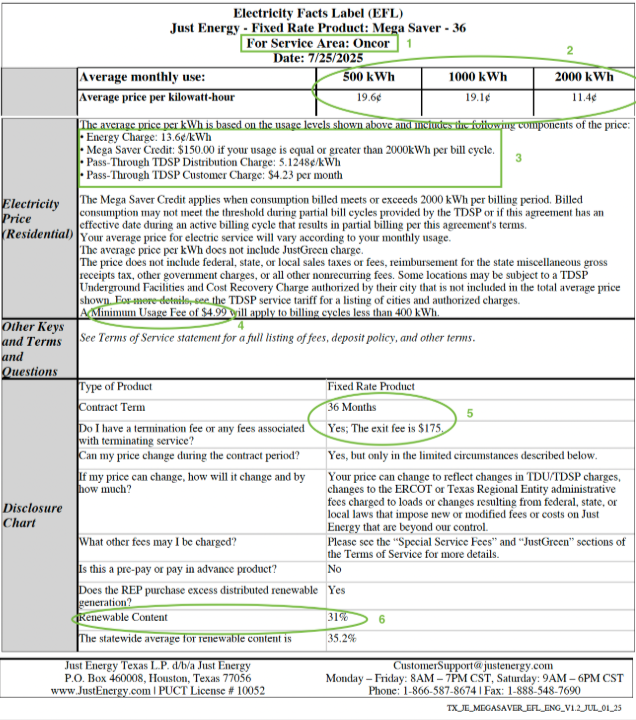
- Oncor is a Texas TDU serving the 75068 zip code. Oncor serves other Texas zip codes as well.
- The electricity price per kilowatt-hour at three different usage levels.
- These are all the components that make up the average electricity rate. This includes Energy charge, TDU charges, and the base charge. This also factors in any bill credits.
- An added fee if you use less than 400 kWh in your billing cycle.
- The length of your contract term and early termination fee.
- The percent of this energy plan that comes from renewable sources
Free Weekends Just Energy EFL Example
Here’s another example from the same 75068 zip code, but using an EFL from one of Just Energy’s free weekends plan.
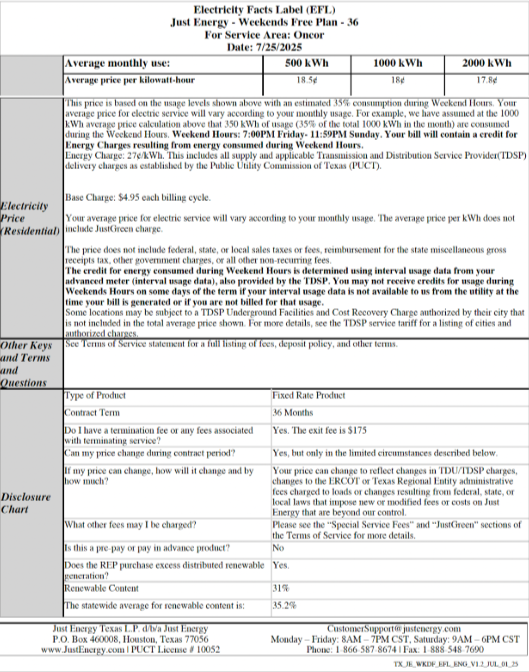
This plan offers free electricity from 7:00 p.m. Friday to 11:59 p.m. Sunday. The EFL explains exactly how this works and how it affects your rate.
Key details from the EFL (36-month plan):
- Free usage credit: Based on an estimate that 35% of your usage occurs during free weekend hours
- Energy charge: 27¢/kWh (includes supply and TDU delivery charges)
- Base charge: $4.95 per billing cycle
- Estimated average price per kWh:
- 500 kWh: 18.5¢
- 1,000 kWh: 18¢
- 2,000 kWh: 17.8¢
Electricity Facts Label (EFL) FAQs
What is an Electricity Facts Label?
An Electricity Facts Label is a standardized document that breaks down a plan’s pricing, fees, contract terms, and renewable content. It helps you compare electricity plans side by side before signing up.
Are delivery charges included in the EFL price?
Yes. The average price listed includes both energy and utility delivery charges. See the Utility Delivery Charges row of the EFL to see a breakdown of charges.
Ready to Choose Your Electricity Plan?
Now that you know how to read an Electricity Facts Label in Texas, you’re better equipped to compare rates, spot hidden fees, and pick a plan that fits your household’s needs.
Just Energy makes it easy — every plan on our site includes a direct link to the EFL, so you can review the full details before you enroll. No surprises. Just clear, upfront pricing.
Same Day Spark
Sign up before 12:00 pm CT, and we’ll have your power up and running the same day.