

If you’ve ever looked closely at your Texas electricity bill, you’ve probably noticed a line item for Texas TDU delivery charges. These fees may feel confusing or even unnecessary, especially when you’ve already agreed to pay a retail electricity provider for your plan.
But TDU charges aren’t an extra cost dreamed up by your provider. Instead, they’re regulated fees that keep the state’s electric grid running. Every Texan pays them, no matter which company supplies their electricity.
Our Just Energy team shares what TDU delivery charges are, why they appear on your bill, and how they affect the total cost of powering your home or business.
Find out why over a million customers trust Just Energy!
What Is a TDU Charge?
TDU delivery fees in Texas are the charges you pay to the Transmission and Distribution Utility (TDU) serving your area. They’re also sometimes referred to as utility charges. The Public Utility Commission of Texas (PUCT) reviews and approves all TDU charges, so your electricity provider doesn’t control or change them.
Meaning of TDU (Transmission and Distribution Utility)
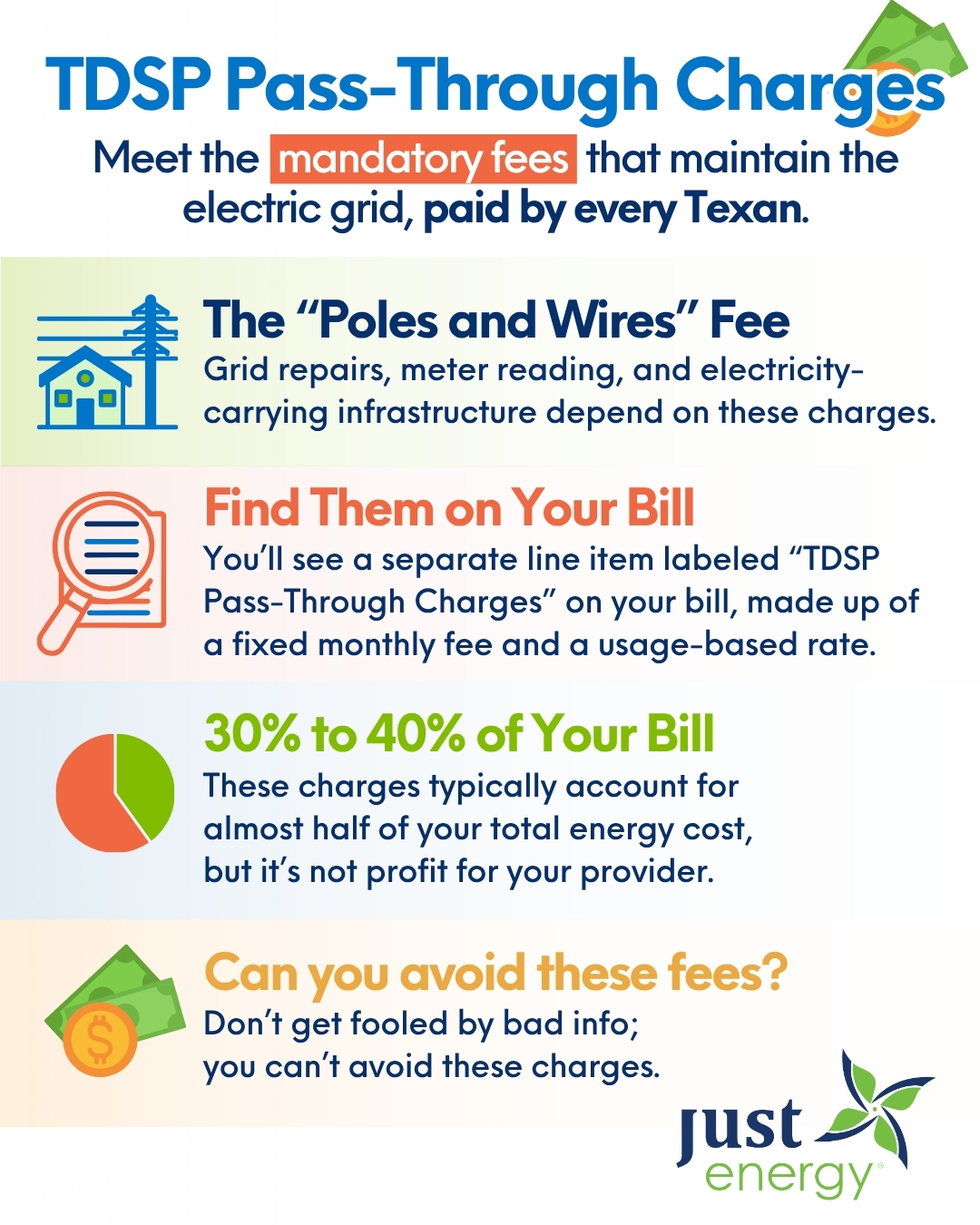
While your retail electricity provider sells you an energy plan, the TDU is the company that owns and maintains the poles, wires, and meters that carry electricity to your home or business.
TDU charges help pay for building and repairing that system, restoring power after storms, and reading your meter each month.
How to Find TDU Fees on Your Bill and EFL
On your bill, TDU delivery charges appear as a separate line item. They’re usually split into two parts:
- A fixed monthly fee: a set amount you pay no matter how much electricity you use.
- A usage-based fee: a charge for every kilowatt-hour (kWh) of electricity delivered.
You’ll see both on your bill regardless of your energy provider.
To check them before you sign a contract, read the Electricity Facts Label (EFL) for your plan. The EFL has your electricity bill breakdown for Texas, listing your provider’s energy rate plus the current TDU delivery charges. Since TDUs update their rates periodically with PUCT approval, TDU charges may change even if your energy rate is locked in.

Texas TDU delivery charges are set through a formal process overseen by the Public Utility Commission of Texas (PUCT). The PUCT reviews each TDU’s costs for building, maintaining, and upgrading the grid, then decides how much they’re allowed to charge customers. Retail electricity providers simply pass these charges through to you.
That’s why you’ll see the same TDU fees on your bill no matter which company sells you electricity. By keeping rate setting in the hands of the PUCT, Texas aims to ensure that charges are fair, consistent, and tied to actual system needs.
Role of the Public Utility Commission of Texas (PUCT)
The PUCT is the state agency responsible for regulating electricity, water, and telecommunications in Texas. For electricity, its main role is making sure the wires-and-poles side of the industry is run safely and fairly.
When a TDU wants to adjust its fees, it has to file a rate case with the PUCT. The Commission reviews evidence, hears from stakeholders, and then issues a decision on whether the proposed charges are reasonable.
This process ensures Texans don’t get overcharged, while still allowing TDUs to cover the real costs of maintaining and upgrading the power grid.
While the PUCT regulates delivery charges, the Electric Reliability Council of Texas (ERCOT) manages the state’s grid operations, balancing supply and demand across more than 27 million customers.
What Factors Influence TDU Delivery Charges?
Several factors go into how much you pay in TDU delivery charges:
- Infrastructure costs: Building and maintaining poles, wires, and substations.
- Repairs and restoration: Recovering from storms or equipment failures.
- Upgrades: Modernizing the grid for growth, safety, or reliability.
- Administrative costs: Meter reading, customer service, and compliance.
Texas electric infrastructure faces unique challenges. Hot summers drive up air conditioning demand, while severe winter storms, such as the 2021 winter storm Uri freeze, can damage equipment and cause major power outages.
TDUs must prepare for both extremes, which adds to system costs. These expenses are reviewed by the PUCT before being included in your delivery charges.
Referrals Pay Off. $75 for You. $75 for Them.*
Earn bill credits for every referral who signs up for a residential electricity plan.
TDU Delivery Charges by Region
Each region has one TDU responsible for delivering power, and their rates vary slightly. That’s why a customer in Houston may pay different TDU delivery charges than someone in Dallas or Corpus Christi, even if both are on the same retail electricity plan.
These differences reflect the costs of maintaining power lines, equipment, and service in each area. Urban areas like Houston may have higher expenses for equipment upgrades and storm recovery, while rural areas can cost more to serve because lines stretch longer distances between customers.
TDUs in Texas
The state’s electric grid is divided into four main TDU service areas:
- Oncor: Covers Dallas–Fort Worth and much of North Texas.
- CenterPoint Energy: Serves the Houston metro area.
- AEP Texas: Handles Central, South, and West Texas regions.
- Texas-New Mexico Power (TNMP): Provides service in smaller areas across Texas.
- Lubbock Power & Light: Services the Lubbock and small surrounding area.
Learn more about the difference between utilities and energy providers here.

How TDU Fees Impact Your Total Electricity Bill
TDU delivery charges aren’t just a small add-on. They typically make up 30% to 40% of the average residential electricity bill, based on current PUCT rate schedules.
For example, if you use 1,000 kWh in a month, you might pay about $120 for energy costs (through your retail provider) plus $60 to $80 in TDU fees, depending on your region.
That means almost a third to nearly half of your total bill goes toward maintaining the poles, wires, and systems that deliver your power. Knowing this breakdown helps you compare plans with a clearer picture of total costs.
Can You Avoid or Reduce TDU Charges?
No, there’s no way to avoid or reduce your Texas TDU delivery charges. These charges apply no matter which retail electricity provider you choose and are approved by the PUCT.
However, you’re not powerless when it comes to your electricity bill. Here are some things to know.
Common Myths
One common myth is that electricity providers “add” TDU charges to your bill to make an extra profit. That’s not true. Providers are required by law to pass these charges through exactly as the TDU sets them, without any markup.
Another myth is that switching to a different retail electricity provider can lower your delivery charges. It can’t. The delivery charges remain the same for everyone in your region, regardless of the retail plan you choose.
What You Can Control
While you can’t change the TDU delivery fees themselves, you can control how much electricity flows through the wires. That directly affects the variable portion of your energy bill that comes from your TDU. You can help lower the kWh charge on your bill by:
- Using energy-efficient appliances (not energy vampires)
- Managing thermostat settings
- Reducing peak-time usage
Together, these steps may help offset delivery costs and keep your overall monthly bill in check.

Serving Texas for Over 20 Years
Trust the legacy – we've proudly served the Lone Star State for over 20 years, delivering first-class energy solutions that stand the test of time.
Understanding Texas TDU Charges & Empowering Consumers
Texas TDU delivery charges are a required part of every Texas electricity bill. They cover the cost of delivering power safely and reliably, and they’re set by the PUCT, not by your retail electricity provider.
While you can’t avoid these fees, knowing how they work helps you better understand your energy bill and compare electricity plans more effectively. When you know that 30–40% of your total bill may come from delivery charges, you can shop smarter and focus on the parts of your bill you can actually control.